UK infosec experts flag concern over NHSX contact tracing appLaurie ClarkeNS Tech

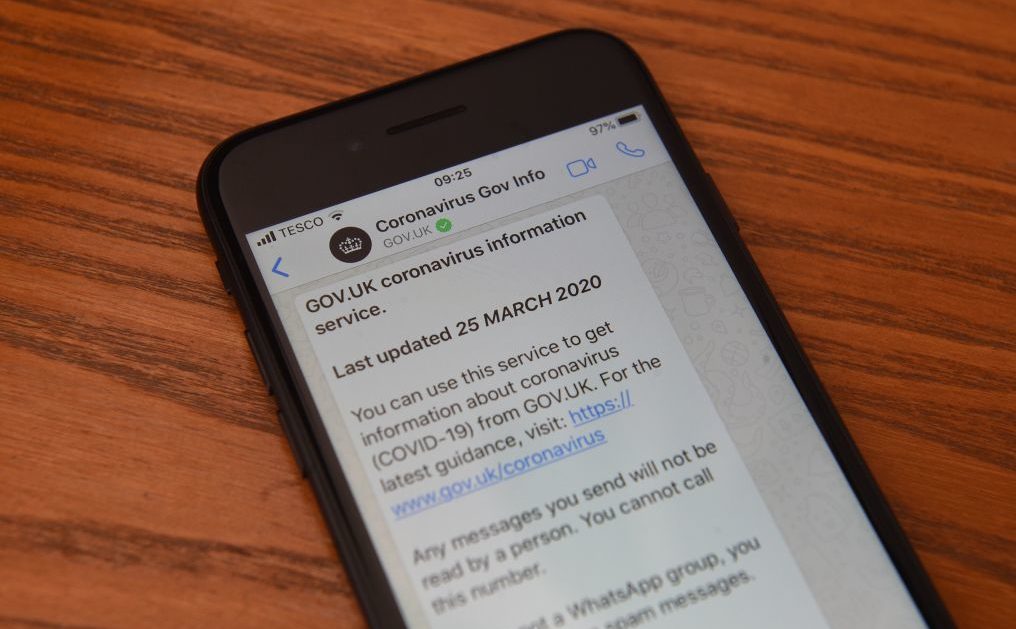
Mobile app displaying a text message from the government

This is the sort of reason why I don’t trust the state with my data as much as I trust many private companies. Apple and Google have worked together (itself a minor miracle) to develop a method of contact tracing that does not collect personal data and does not invade people’s privacy.

NHSX has rejected that model in favour of one that will enable them to deanonymise people, and store that information in a centralised database. This is the surveillance state. It risks reducing goodwill towards the NHS and other public institutions.

A statement for medical privacy campaign group Medconfidential reads: “Given NHSX has chosen to build an unnecessary massive pool of sensitive data, it must ensure that the data is well protected. With combined effort, GCHQ and NHS Digital will likely be good at defending the big pool of sensitive data. But there is no need to have that data. The best way to make sure data doesn’t leak, is to have chosen the method that never collected it.”

Principles and prioritiesJeremy KeithAdactio

What makes a good principle? How do you avoid principles that are mere motherhood and apple pie? According to Jeremy Keith, it’s all about establishing priorities.

He goes on to outline the danger of prioritising the experience of developers or designers above the user experience. He makes an interesting observation about a perceived difference in the way developers, er, develop and the way designers do.

Developer efficiency is prized above all else. Like I said, that would be absolutely fine if we’re talking about technologies that only developers are exposed to, but as soon as we’re talking about shipping those technologies over the network to end users, it’s negligent to continue to prioritise the developer experience…

I’ve been talking about developers here, but this is something that applies just as much to designers. But I feel like designers go through that priority shift fairly early in their career. At the outset, they’re eager to make their mark and prove themselves. As they grow and realise that it’s not about them, they understand that the most appropriate solution for the user is what matters, even if that’s a “boring” tried-and-tested pattern that isn’t going to wow any fellow designers.

Meeting the challenges of conducting user research remotelyWebsite and Communications Blog

A laptop displaying a user interface

The coronavirus outbreak has posed massive challenges for everyone in society. For practitioners of human-centred approaches to design, where face-to-face interaction is often so important to enhancing our understanding, our current requirement to maintain social distancing creates obvious barriers.

However, this doesn’t mean our work to ensure we’re meeting people’s needs has to stop. In fact, there are some perhaps surprising advantages to working remotely as a user experience practitioner.

Over on my team’s blog, I have outlined some of what I’ve learned about remote user research over the past month or so.

How will humans, by nature social animals, fare when isolated?The Economist

Illustration of a glum-looking woman sitting at a desk in a dark room

I have worried about the social and mental health effects of the lockdown measures being implemented. But even I hadn’t anticipated quite how much conditions like post-traumatic stress disorder appear to be common following quarantines.

According to a rapid review of the psychological effects of quarantines, published on March 14th in the Lancet, a British medical journal, some studies suggest that the impact of quarantines can be so severe as to result in a diagnosis of post-traumatic stress disorder…

One study from 2009 looked at hospital employees in Beijing who in 2003 were exposed to severe acute respiratory syndrome (SARS), which, like covid-19, is caused by a coronavirus. The authors found that, three years later, having been quarantined was a predictor of post-traumatic-stress symptoms. Another study… found that the mean post-traumatic-stress scores were four times higher in children who had been isolated.

Elsewhere, the article highlights as a problem the fact that 67% of 18–34-year-olds are finding it hard to remain upbeat. But I’m more concerned about those who are managing to be upbeat among all this madness.

People with mental health conditions say the coronavirus has plunged UK treatment services into crisisAlex SpenceBuzzFeed News

A person pasting a poster to a wall. The poster says: "Be kind. Let's look out for one another."

The effects of coronavirus and the lockdown on people with mental health conditions.

I fear that when this pandemic is over, the actual death toll will number far higher than those whose deaths were directly caused by Covid-19. I foresee a mental health crisis with no resources left to deal with it.

HTML: The Inaccessible PartsDave Rupert

Following on from Gov.UK’s revelation about <input type="number">, Dave Rupert has compiled a list of other bits of HTML that can cause inadvertent accessibility issues.

There are some cases where even using plain ol’ HTML causes accessibility problems. I get frustrated and want to quit web development whenever I read about these types of issues. Because if browsers can’t get this right, what hope is there for the rest of us.

Not that we should give up, of course.

McKinsey: CEOs have no clue what chief design officers doMark WilsonFast Company

Picture of a hipster drinking coffee with headphones hanging of a massive Mac screen. I guess that's what a designer is.

Talk about designers “having a seat at the table” generally leaves me cold. But this useful article explains why it can matter — but why designers have a duty to do more than simply be at the table.

Evidence has long suggested that companies with a strong design focus are more successful. The example of Logitech outlined here bears that out.

But if some CEOs don’t understand the value of design, it’s up to designers to articulate it properly.

Why the Gov.UK Design System team changed the input type for numbersHanna LaaksoTechnology in government

Numeric keypad interface

The Gov.UK Design System team have discovered that using the HTML element <input type="number"> creates some surprising problems in certain environments.

Some of the limitations in assistive technologies such as Dragon Naturally Speaking are disappointing but unsurprising.

But Chrome deciding to convert large numbers to exponential notation is rather more eyebrow-raising. Then there is Safari adding commas to long numbers that are in fact credit card numbers. You have to wonder about some of the decision-making among browser vendors.

Coding is for everyone — as long as you speak EnglishGretchen McCullochWired

This year marks the 30th anniversary of the World Wide Web, so there’s been a lot of pixels spilled on “the initial promises of the web”—one of which was the idea that you could select “view source” on any page and easily teach yourself what went into making it display like that.

This article makes a great point about how this promise only truly works if you can speak English.

The process described above is exactly how I learned HTML. The fact that I would have to use “color” instead of “colour” is a mildly amusing inconvenience. I hadn’t really considered before how it must feel if you don’t speak any English.

I don’t speak Russian, and assuming you don’t either, does <заголовок> and <заглавие> and <тело> and <п> still feel like something you want to tinker with?