
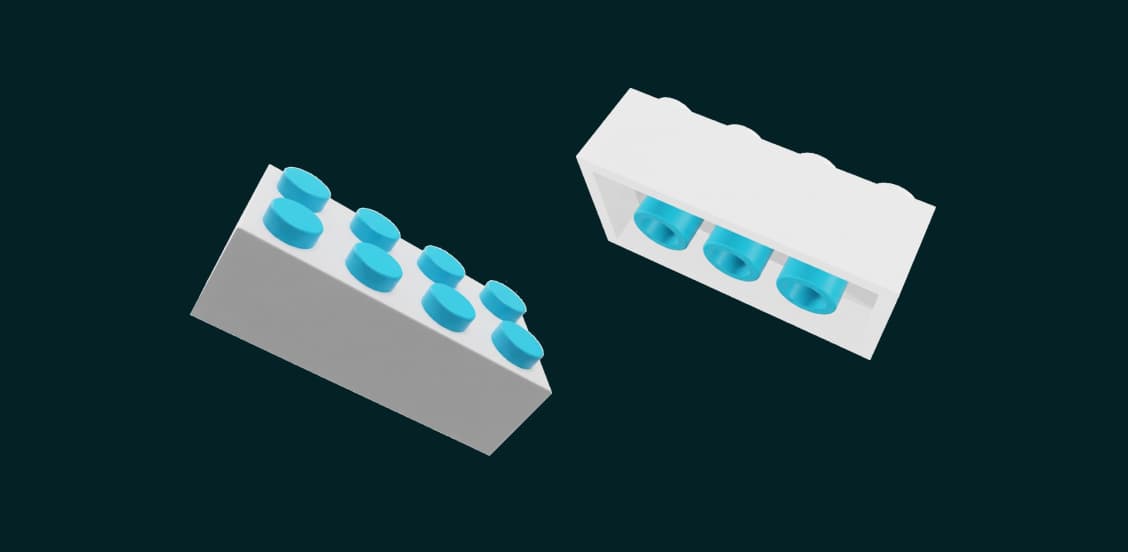
Anyone working in digital is bound to reach for a Lego analogy at some point. This is especially the case if you are working on a modular system — a thing made up of smaller things.
Information architecture has its fair share of Lego analogies. We like talking about Lego because… well, everyone loves Lego. And it makes abstract concepts more tangible for people.
We all know how Lego works. You take a brick, and you add another brick, then a few more bricks. Finally you have your result. A pile of bricks becomes your vision.
Lego analogies disguise important elements
But there is a problem. This analogy disguises the very thing that makes these structures actually hold together. And it’s those invisible parts that we need to focus on more.
A structure is not just made of bricks. It is also made of the connections between the bricks.
In an information model, we identify the things — our entities, our objects, our nodes. Our bricks.
But we also define the connections between those things — the relationships, the connections, the edges. In Lego, these are also achieved through the bricks themselves.
Lego cleverly combines those two functions — the thingness and the connectedness — into one. It seems as though the bricks are the connections.
The inconspicuous connections within Lego bricks
The truth is a bit more nuanced than that. Because Lego bricks have their own microstructures.
The connectedness of Lego bricks comes from clutch power — the friction that holds pieces together. This clutch power comes from parts of Lego that we rarely name, and barely notice as distinct parts.
The studs on the top of the brick connect to the tubes on the bottom of the brick.
This is such an effective connection system that we often don’t even think of them as a separate function to the core brick itself. We normally only perceive the whole bricks in this system.
A good structure is made of more than bricks
This is what makes the Lego analogy fail as a way of describing modular digital systems. Talking about Lego tricks us into thinking that a good structure needs the bricks alone.
But the earliest Lego bricks, which came without tubes, formed poor structures. To make the system work, Lego had to evolve to include the tubes for the studs to connect to.
A Lego structure without its connective studs and tubes would fall apart easily, just as we wouldn’t trust a building built of bricks without mortar.
Information architecture is about the connections between things
In a similar fashion, our information models would fall apart if we did not define the relationships between our objects. In a way, information architecture is more about identifying the connections between things, rather than the things themselves.
Our systems are not made up just of a collection of things. Those things exist in relation to each other. And the nature of those relationships are a fundamental property of our information systems.
Property being the operative word. In the RDF (the Resource Description Framework), the relationship between a subject and an object is called a property. In RDF, properties are first-class citizens — as important as the objects they connect.
But often those relationships are harder to perceive than the things themselves. So we need to work harder to shine a light on their importance.
Potential alternatives to Lego analogies
That means we need to drop the Lego analogies. (Which is a shame, because everyone loves Lego.)
As for a potential alternative, I was really struck when at the Taxonomy Boot Camp conference earlier this year Dave McComb used Tinkertoys to describe ontologies. With Tinkertoys, spools are connected together using sticks. It looks remarkably like a graph visualisation with nodes and edges.
I also like talking about networks. The road network is a good example. It is easy for us to grasp that it is the road that takes us to a place, and that there can be multiple routes to the same place.
It is also an intuitive demonstration of how the information architecture — the road network — is not the same as the navigation — the road signs. And that neither the information architecture nor the navigation is the same as the map.
Likes