Card sorting has informed a new information architecture for Learn coursesWebsite and Communications Blog

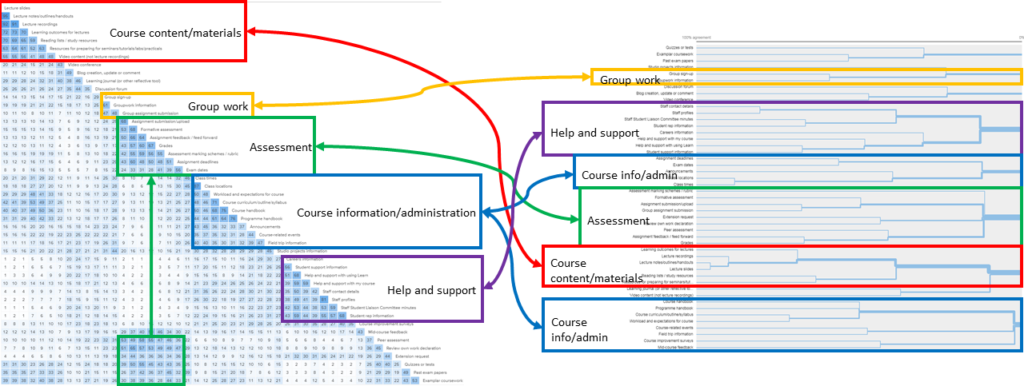
Results of the card sorting study

How we used card sorting to help us devise a consistent information architecture for Learn VLE courses at the University of Edinburgh.

775 students participated in the study — and no two students submitted the same card sort. This highlights the great challenge faced by the Learn Foundations project in attempting to create a more standardised template that meets the wide variety of needs across the University.

My Omnichord normally gathers dust in the corner of a room. So when someone retweeted into my timeline Karine Polwart asking if anyone in Edinburgh had an Omnichord she could borrow for some filming, I was happy to help, and to see the Omnichord out of its case for a change!

It makes its little appearance in this video for her cover of Chance by the Big Country.

This is part of her new album of Scottish covers, Scottish Songbook. It’s out today on lovely red vinyl.

My name on the back sleeve of Scottish Songbook

I had always wondered what it would take to get a ‘thank you’ on the back of an album. Now I know. 🙂

Hopefully one day I’ll get round to playing the Omnichord more often myself…

The one thing about your spouse’s personality that really affects your careerAndrew O’ConnellHarvard Business Review

Two pairs of sandals

It has been found that having a conscientious spouse helps lead to an increase in income, number of promotions and job satisfaction. Why?

> First, conscientious spouses handle a lot of household tasks, freeing employees to concentrate on work (“When you can depend on someone, it takes pressure off of you,” Solomon told me).

Or, put another way, if someone else is doing all the dirty work at home, it gives you the privilege to focus on your career.

I wonder if there’s research to say what the effect is if both people in a relationship share household duties equally. Hopefully if both partners are conscientious, both feel the benefits in their careers.

Support each other. Teamwork! 🐌🐢

> You can support your spouse in supporting you. If you depend on his or her reliability, diligence, and goal orientation, don’t take those traits for granted. Maybe you’ve been standing heroically at the bow for so long that you’ve forgotten how much effort it takes to row. So sit down and row for a while.

Creating the perfect UX workshop bag@kyecassUX Collective

✔️ Love stationery
✔️ Love workshops

This is a great guide to workshop essentials. I’m impressed that this kit contains a wider variety of materials, and yet seems so much smaller than the workshop bag we use at work. Maybe we rely too much on mountains of sticky notes!

I’d be tempted to add [planning poker](https://www.mountaingoatsoftware.com/agile/planning-poker) cards to this list. Planning poker is usually thought of as a technique for estimating work in agile projects. But it can also be used as a prioritisation technique in workshops.

What is co-design?Kelly Ann McKercherBeyond Sticky Notes

Venn diagram describing co-production as an overlap of co-planning, co-design, co-evaluation and co-delivery

I’ve been thinking and reading a lot about co-design recently (as well as doing some of it too). This website, Beyond Sticky Notes, has provided me with even more food for thought.

I am particularly struck by the table describing various approaches from transactional to transformational. In this model, “Anything ‘centred’ — human, user, patient etc.” is little better than “Designer as expert”. Meanwhile, what I thought of as co-design may actually be more like participatory design. There’s so much more to do.

But one line of warning is familiar to any good user experience practitioner, and is worth repeating until the cows come home.

Co-design builds long term commitment. By contrast, consultation often gives the illusion we’ve bought people on board — only to have them then fall overboard. With consultation, we pay later — often in costly, public and damaging ways.”

Make sure you also see Mindsets for co-design, another enlightening article on how to do co-design better.

This website is in support of a book due to be published in 2020. I am now looking forward to it.

Thanks to Alison Wright who retweeted the latter article and brought it to my attention.

Apple contractors ‘regularly hear confidential details’ on Siri recordingsAlex HernThe Guardian

Apple device with Siri activated

Apple contractors regularly hear confidential medical information, drug deals, and recordings of couples having sex, as part of their job providing quality control, or “grading”, the company’s Siri voice assistant, the Guardian has learned.

Looks like Apple’s big claims on privacy are — like most things from Apple — a superficial marketing line.

Top tasks surveys have identified what really matters to students using LearnWebsite and Communications Blog

Pie chart of students' top tasks in Learn

As part of our programme of user research in support of the Learn Foundations project, we have carried out a top tasks survey to understand what students need when accessing course materials online.

What we found was that students value three items much more than everything else. Those items are *all* to do with lectures.

See the full post to find out more.

The elements of a better user experience in LearnWebsite and Communications Blog

The sketch that started it all

As part of the Learn Foundations project, we have carried out a programme of quantitative research to ensure a user-centred approach to solution development.

The Learn Foundations project team wanted to develop a new template using a user-centred approach. This template would be designed to introduce more consistency between different courses in Learn. But it also had to support a diverse variety of needs across different courses, supporting different schools, colleges and teaching needs. It also had to be developed quickly.

We took inspiration from a classic user experience diagram to ensure this new template could be built on firm foundations.

This post introduces the steps we took. Forthcoming posts will describe each step in more detail and some of our key findings.