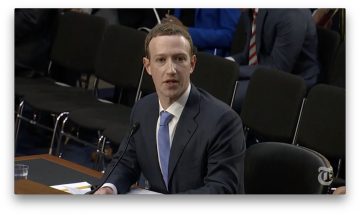
The media vs tech battle that nobody can win

Yet again, Thomas Baekdal has a genuinely informative and enlightening take on the turf war the media is trying to wage against tech companies.

Essentially, traditional media and technology are trying to solve a similar problem — but from different directions.

We accept that newspapers can’t cover everything in exchange for a demand for higher quality reporting for the things they do pick. And we accept that, on channels such as YouTube, we will always be able to find the occasional piece of bad content, in exchange for the flexibility and the wealth of things that we can see.

It strikes me that we need to have both. We already knew that good journalism and high-quality media products will always exist. But they need to focus on making those high-quality products rather than constantly reacting in counter-productive ways to the perceived threat of technological change.

WhatsApp founder plans to leave after broad clashes with parent Facebook

Jan Koum, the co-founder of WhatsApp, is leaving. Apparently, he clashed with Facebook over how they use WhatsApp users’ personal data.

This comes just months after the other co-founder of WhatsApp, Brian Acton, left — and endorsed the hashtag.

[E]ven in the early days, there were signs of a mismatch… Koum and Acton were openly disparaging of the targeted advertising model…

The WhatsApp co-founders were also big believers in privacy. They took pains to collect as little data as possible from their users, requiring only phone numbers and putting them at odds with data-hungry Facebook.

All of which gets me wondering, why did they even sell up to Facebook in the first place? 🤔

The Facebook algorithm mom problem

An excellent description of one of the reasons I developed a distaste for Facebook for.

I write my content on my own personal site. I automatically syndicate it to Facebook. My mom, who seems to be on Facebook 24/7, immediately clicks “like” on the post. The Facebook algorithm immediately thinks that because my mom liked it, it must be a family related piece of content…

The algorithm narrows the presentation of the content down to very close family. Then my mom’s sister sees it and clicks “like” moments later. Now Facebook’s algorithm has created a self-fulfilling prophesy and further narrows the audience of my post. As a result, my post gets no further exposure on Facebook…

How can we incentivise the digital world to make safer services?

How regulation came to be in railways, engineering and cars — and what this tells us about how digital services may be regulated.

Trigger points for regulation have varied depending on the field, the period of history and the country. However, the thing all these triggers have in common is a change in attitudes. People need to demand change to incentivize companies to make their products and services safer.

Google AMP for Email: What it is and why it’s a bad idea

I have been following the controversy around AMP fairly closely. A lot of people whose opinions I respect are against AMP generally, although I still cautiously think AMP is generally a good thing. At least, it is in my view clearly better than Facebook Instant Articles.

So if AMP is Google’s response to Facebook, I am in favour of it. Facebook’s interest is clearly to keep people in the Facebook ecosystem. AMP may give Google some a bit of control over content, but it still keeps it fundamentally of the web. At least you don’t have to use Google to use AMP.

However, AMP for Email seems far more obviously bad. Not least because, as this article points out, it appears to be a solution looking for a problem.

There may be cause to be wary of Google’s intentions after all.

Reporting findings to the API Service team

Bringing focus to our findings: continued user research for the API Service

This is the final blog post in my short series about the [user research I led on for the API Service at the University of Edinburgh](https://website-programme-blog.is.ed.ac.uk/bringing-focus-to-our-findings-continued-user-research-for-the-api-service/).

This post covers the second half of the research, where we brought focus to the detailed picture developed in the first phase, and began to prioritise the issues to help the API Service team direct their ongoing work.

Dear developer, the web isn’t about you

A call to stop the madness and focus on making the web a better platform for people, and not the technologist’s playground it’s becoming. It’s lengthy, but well worth it.

There is so much good stuff here, but I particularly enjoyed this section on the obsession with JavaScript.

Instead of HTML being generated on, and delivered from, the server, a JS bundle is sent to the client, which is then decompressed and initialised and then requests data, which is then sent from the server (or another server, as now everything is a service) as JSON, where it is then converted on the fly into HTML.

Permit an old lady to rant here…

Because to me, this is rather akin to building a Boeing 747 to commute to work.

🙌

Design flaws in electronic health records can harm patients, study finds

We know that poor usability can lead to disastrous consequences. Think to the recent case of the accidental missile alert in Hawaii.

This is a more rigorous, academic investigation into the negative consequences of poor usability in electronic health records. The study even suggests that bad usability may have caused deaths.

Some 557 (0.03 percent) reports had “language explicitly suggesting EHR usability contributed to possible patient harm,” and among those, 80 caused temporary harm, seven may have caused permanent harm and two may have been fatal.

MySpace Tom beat Facebook in the long run

“Wouldn’t you rather be a rich nobody than whatever Mark Zuckerberg is?”

I love this perspective. Tom from MySpace may have been a bit of a laughing stock for a while. But you have to say, he must be feeling a bit better than Mark Zuckerberg is right now.

It puts MySpace’s failure to evolve in a new light, as perhaps the healthy thing is for a platform to die and for everyone to move on.