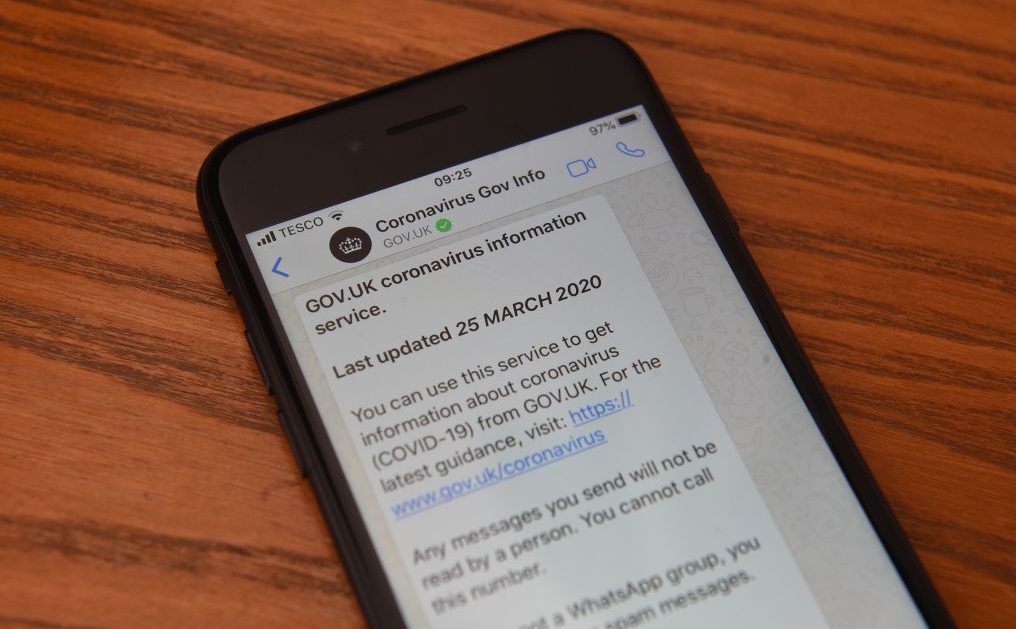
UK infosec experts flag concern over NHSX contact tracing app — Laurie Clarke — NS Tech

Mobile app displaying a text message from the government

This is the sort of reason why I don’t trust the state with my data as much as I trust many private companies. Apple and Google have worked together (itself a minor miracle) to develop a method of contact tracing that does not collect personal data and does not invade people’s privacy.

NHSX has rejected that model in favour of one that will enable them to deanonymise people, and store that information in a centralised database. This is the surveillance state. It risks reducing goodwill towards the NHS and other public institutions.

A statement for medical privacy campaign group Medconfidential reads: “Given NHSX has chosen to build an unnecessary massive pool of sensitive data, it must ensure that the data is well protected. With combined effort, GCHQ and NHS Digital will likely be good at defending the big pool of sensitive data. But there is no need to have that data. The best way to make sure data doesn’t leak, is to have chosen the method that never collected it.”

Adapted from a post originally published on the University of Edinburgh Website and Communications blog. The coronavirus (Covid-19) outbreak has posed massive challenges for everyone in society. For practitioners of human-centred approaches to design, where face-to-face interaction is often so important to enhancing our understanding, our current requirement to maintain social distancing creates obvious barriers. […]

How will humans, by nature social animals, fare when isolated? — The Economist

Illustration of a glum-looking woman sitting at a desk in a dark room

I have worried about the social and mental health effects of the lockdown measures being implemented. But even I hadn’t anticipated quite how much conditions like post-traumatic stress disorder appear to be common following quarantines.

According to a rapid review of the psychological effects of quarantines, published on March 14th in the Lancet, a British medical journal, some studies suggest that the impact of quarantines can be so severe as to result in a diagnosis of post-traumatic stress disorder…

One study from 2009 looked at hospital employees in Beijing who in 2003 were exposed to severe acute respiratory syndrome (SARS), which, like covid-19, is caused by a coronavirus. The authors found that, three years later, having been quarantined was a predictor of post-traumatic-stress symptoms. Another study… found that the mean post-traumatic-stress scores were four times higher in children who had been isolated.

Elsewhere, the article highlights as a problem the fact that 67% of 18–34-year-olds are finding it hard to remain upbeat. But I’m more concerned about those who are managing to be upbeat among all this madness.

People with mental health conditions say the coronavirus has plunged UK treatment services into crisis — Alex Spence — BuzzFeed News

A person pasting a poster to a wall. The poster says: "Be kind. Let's look out for one another."

The effects of coronavirus and the lockdown on people with mental health conditions.

I fear that when this pandemic is over, the actual death toll will number far higher than those whose deaths were directly caused by Covid-19. I foresee a mental health crisis with no resources left to deal with it.

Me holding a bottle of Corona

Virtual birthday party — 9pm tonight

It’s my birthday today. But I couldn’t really be bothered to organise a physical get-together. Instead, I thought it would be fun to imagine there was some horrific virus that meant we couldn’t really leave the house much, and I had to celebrate it remotely.

Update: This will now take place at 9pm, not 7pm as before.

Join us at 9pm for 40 minutes of free Zoom-based party times.

Bring your own Corona.

Coding is for everyone — as long as you speak English — Gretchen McCulloch — Wired

This year marks the 30th anniversary of the World Wide Web, so there’s been a lot of pixels spilled on “the initial promises of the web”—one of which was the idea that you could select “view source” on any page and easily teach yourself what went into making it display like that.

This article makes a great point about how this promise only truly works if you can speak English.

The process described above is exactly how I learned HTML. The fact that I would have to use “color” instead of “colour” is a mildly amusing inconvenience. I hadn’t really considered before how it must feel if you don’t speak any English.

I don’t speak Russian, and assuming you don’t either, does <заголовок> and <заглавие> and <тело> and <п> still feel like something you want to tinker with?

Dutch “singing road” silenced after villagers complain: “I’m going nuts” — Palko Karasz and Yonette Joseph — The New York Times

A car driving over the musical rumble strips

This must be the most spurious “road safety” feature ever conceived.

A Dutch town decided to install rumble strips that are set at certain frequencies so that cars “play” the regional anthem as they drive over them.

This article focuses on the fact that this feature is driving residents crazy as they repeatedly have to hear this raspy version of the same melody all day (and night) long.

But surely the spurious justification is more deserving of ire.

Local officials hoped the strips would encourage drivers to stick to the speed limit.

Because, apparently, the melody would only play when drivers are driving at the right speed. Except, as officials concede later in the article, that’s not even true. If you drive at a different speed, the melody still plays — just at a different speed. Perhaps drivers may even speed up just to end the din more quickly.

What a terrible idea!

This article also contains a brilliant video from Tom Scott demonstrating an even more disastrous version of the same idea, in California.

Why being kind could help you live longer — Lauren Turner — BBC News

Illustration of hands holding hearts

It has long been known that being kind to others makes you feel good and can improve your mental health. Now it seems there is a growing body of evidence suggesting that it can increase your life expectancy.

“Living with people who treat you, at best, with disregard or a lack of concern, and at worst with open hostility, is bad for you. It shortens your life, quite literally,” [Daniel Fessler] says.

“Conversely, both receiving kindness from others, and providing kindness, both of those things are the antithesis of this toxic stress situation. And they’re good for you.”