User research into the needs of students and staff using LearnWebsite and Communications Blog

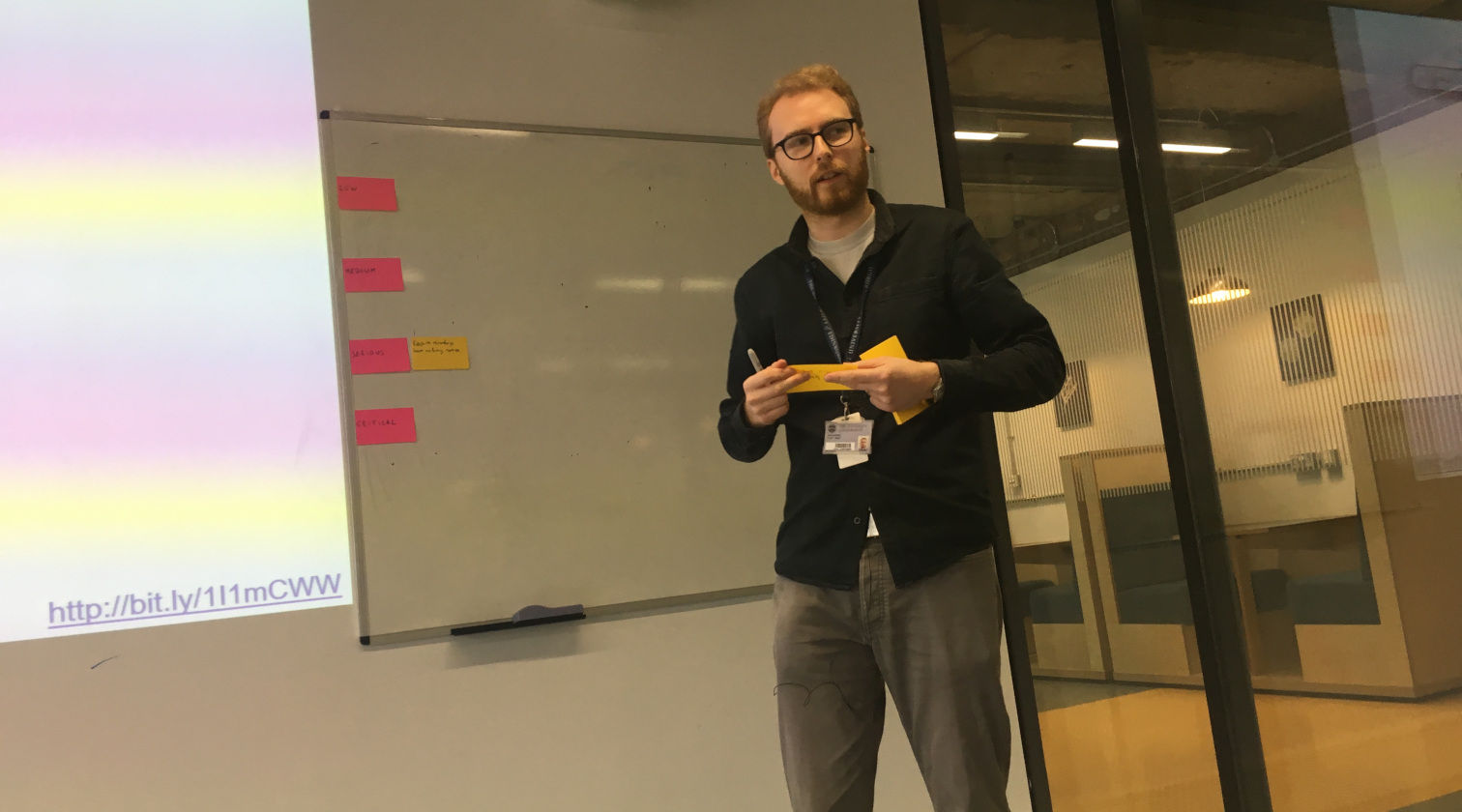
Me running a workshop for Learn Foundations

Since September, my main focus at work has been to carry out a comprehensive programme of user research for a project aiming to improve services surrounding Blackboard Learn, the University of Edinburgh’s main virtual learning environment.

I wrote this blog post providing a high-level overview of all the work that’s taken place this academic year. More detailed blog posts about each of the strands of research will come in due course.

This is been a brilliant project to be involved in. We’ve been given a lot of time and freedom to do large amount of research in support of one of the university’s most important digital services, used daily by most of our students, and many staff members.

We have made some really important discoveries. This work is ensuring that improvements are based on a strong understanding of users’ behaviour and needs when working with course materials digitally.

Check out this video, where I describe the work and some of the findings in a bit more detail, and keep an eye out for the forthcoming blog posts.

Describing personasIndi YoungIndi’s Essays

Personas are one of the most popular techniques in the user experience toolkit, but they also remain among the most controversial. It is often still unclear to some what value personas can bring, and how to avoid the pitfalls of bad personas.

This article brings one of the clearest explanations I’ve seen of how to make good personas. It is a lengthy but must-read article if you make personas and want to make them work.

This article is particularly useful at explaining why obsessing over demographics is bad, and why you should instead focus on “thinking styles”.

Statements-of-fact, preferences, and demographics frequently serve as distracting barriers. They kick off all kinds of subconscious reactions in team members minds.

Improving student experiences in Learn: usability testing showcase and workshopInformatics Learning Technology Service

Prioritised usability issues

My colleague Alex Burford from the University of Edinburgh School of Informatics has written this great blog post about some usability testing we have conducted in support of the Learn Foundations project.

> I thoroughly enjoyed working with [Duncan Stephen](https://www.ed.ac.uk/profile/duncan-stephen) on this mini project. The feedback was informative, encouraging, and a call to action. I’m looking forward to embedding similar practice across the School for alternative platforms for content delivery.

[You can read my own reflections on this work at the Website and Communications team blog](https://blogs.ed.ac.uk/website-communications/come-to-the-next-learn-usability-testing-showcase-on-29-march/).

Each month we are working with a different school to conduct usability testing in Learn, the virtual learning environment, to inform improvements to the Learn service.

This is just one strand of a huge amount of user research I’ve been carrying out for the [Learn Foundations](https://blogs.ed.ac.uk/website-communications/tag/learn-foundations/) project. It’s been a fascinating and very enjoyable project to work on. I’ve been pretty lax at writing about it yet — but I’ll be posting much more about it soon.

Someone using a screwdriver as a hammer

How harmful is the net promoter score? — Jeff Sauro, MeasuringU

A very useful contribution to the debate surrounding the usefulness/harmfulness of net promoter score. Jeff Sauro transcends the often polemical nature of the debate, by analysing actual research on the effectiveness of net promoter score.

The news still isn’t all that great for proponents of net promoter score. But at the same time, it’s not quite as bad as its detractors make out.

Kudos to Jeff Sauro for doing some actual research on this.

UX your life: Applying the user-centered process to your life (and stuff) — JD Jordan, Smashing Magazine

I’m always in two minds about whether people should use work-based techniques on personal problems. I have heard of people using Trello boards at home to organise tasks, which sounds as nightmarish as it sounds sensible. I’ve even heard of people running scrum-style weekly planning meetings with their family, which definitely sounds overboard to me.

But I do like the look of some of the ideas here. For instance, I’m keen to map out out my life in weeks.

And I already know that affinity mapping can work great at home and for other stuff.

[When we did the MoRun in November](https://duncanstephen.net/this-time-last-week-i-ran-the-edinburgh-morun-5k/), Lauren and I made an affinity map to decide which of two runs to enter. My gut feeling told me another run would be better. But writing down all the pros and cons of each race, and grouping them, made it clear that my gut feeling was actually wide of the mark.

Desire paths

UX past, present, and future

An enjoyable and informative history of user experience. Some familiar themes, but not entirely your standard take. A reminder that people have been doing something like user-centred design for longer than we sometimes think.

…UX is not really a new thing. It might seem new to your organisation and its design process, but in fact it’s been emerging since before the dawn of the internet, back in the 80s, and people have been looking to solve similar problems for almost 140 years.

Keeping it weird

Or, more accurately, stopping it being weird. This refers to the problem that most psychology research is conducted on people that are western, educated, industrialized, rich and democratic.

Tim Kadlec considers the implication this has on our understanding of how people use the web.

We’ve known for a while that the worldwide web was becoming increasingly that: worldwide. As we try to reach people in different parts of the globe with very different daily realities, we have to be willing to rethink our assumptions. We have to be willing to revisit our research and findings with fresh eyes so that we can see what holds true, what doesn’t, and where.

Making work meaningful: A leader’s guide

McKinsey report on how to engage employees.

> People who find meaning at work are happier, more productive, and more engaged. Four practical interventions can help make the search more likely to succeed.

I am struck by how two of the four interventions listed are fundamentally about understanding your users better.

> ### Reduce anonymity
> Talk with employees about who their customers are, and encourage each employee to connect with one.
>
> Build regular, face-to-face interactions with customers into existing processes, stimulating employees to learn who is most affected by their work.
>
> ### Help people grasp the impact of their work
> Invite customers who have had the best—and worst—experiences with your products to talk with employees in person so your team can see how their work affects customers.

Another reason why user experience is worth it.