
This month I attended the Institutional Web Management Workshop at Northumbria University. The conference, aimed mainly at university web managers, has been running for 18 years. The theme of this year was rebooting the web, after a participant at last year’s IWMW suggested the event needed rebooting.
But it feels like the entire institutional web management community as a whole is undergoing a reboot. This is not a bad thing. It is a reflection of the successes of the past, and a signal of the need for us to step up to the challenges of the present and future.
At the University of St Andrews we are currently undergoing a major rethink of the way we go about our work in digital. Although this work is very exciting, it is far from easy.
As usual, it was valuable to go to IWMW. Our colleagues in other institutions are facing the same issues. They are asking themselves the same questions. There is plenty of scope for us all to share information about how to tackle them.
A running theme of IWMW this year surrounded big ideas to do with digital transformation, institutional culture change and what our role within the institution should be. It all fits in well with the work we are doing at the moment.
Institutional web managers are a maligned bunch. Many are dealing with the same barriers, often imposed by an institution that is not yet equipped to properly deal with digital. But we can take heart from the example set by Gov.uk, which has recently transformed the way the government does digital, and even changed the way it goes about its business in a wider sense. We are beginning to see some universities step up to the plate as well.
Digital transformation and the startup playbook
Why we need to transform the way we do digital
On day one of IWMW we were treated to an inspiring talk by Paul Boag from the digital agency Headscape. At the University of St Andrews we have recently had the pleasure of working with him for a day, so a lot of what he had to say was familiar. Some of the examples he used were pretty close to home as well.
Paul says that institutions should engage in a programme of digital transformation. He notes that this wording is carefully chosen.
It is digital because it encompasses the web, social media, e-learning and beyond. Everything needs to be coordinated.
The word transformation emphasises that it is not about creating another service department, as many web teams have traditionally been. No longer should work be driven by who shouts the loudest. The programme should have its own agenda, and those working on it should be the ones to drive its direction.
Changing the institution
Moreover, the programme is not permanent. It is not about creating a team that will exist forever. It is a programme of work aimed at changing the institution. Once that mission is complete the team will disband.
This is not about creating another silo. It is a team to help put digital in the hands of everyone across the organisation.
For me, the key quote in Paul’s talk was: “If we do nothing we don’t stand still; we get swept back.”
Certain universities appear to have a temptation to smugly rely on their past reputations for their future business. Other industries got caught out while resting on their laurels. As a sector we need to avoid being like the music industry or journalism. We need to avoid being like Kodak.
Using the startup playbook
There were plenty of parallels in a following talk by Ross Ferguson, head of the digital marketing and communications team at the University of Bath. His talk was about rebooting a big university website by using the startup playbook.
Ross moved to the University of Bath from the Government Digital Service. So he has a lot of experience changing organisations to make them more focussed on digital.
As Gov.uk moved from alpha to beta to live, the Government Digital Service progressed from just getting the government to rethink its website. It is now changing the way the government and the civil service runs itself.
Ross asked himself if it would be possible to achieve the same at a university. He felt “meh” about most university websites. Similar information architectures, mostly much of a muchness, all following similar models, all focused on selling and marketing.
Let’s face it. The Xkcd comic University Website is true, and deep down we all know it.
Using a radical approach
Ross decided to implement a radical approach based not on any project management methodology, but on six simple principles:
- Put user needs first.
- Make decisions based on data.
- Release iteratively and often.
- Keep things simple and consistent.
- Provide ongoing support.
- Work in the open.
The team takes inspiration from an agile approach, but does not follow a textbook version of scrum. Instead they take what works for them.
With what they deliver, the idea is to focus on producing the minimum viable product, get it in the hands of the users as soon as possible, then iterate and build on it over time. It is like Spotify’s approach to building a product.
There was one particularly refreshing moment of Ross’s talk where he said: “I won’t do gantt charts; I won’t do a project plan; I won’t do a risk register. I won’t ask my team to do it. If you don’t like that, get a new head of digital.”
This all chimes with my own view that running a digital service should not be considered a project, with the usual box ticking for the sake of box ticking that comes with it. Instead, it is about building the right processes that work for your situation, developing a fully open and collaborative culture, and bringing good people in to do a good job.
We are often expected to follow a textbook version of how things should be done. But digital and technology evolves so quickly that the textbook is out of date by the time it has been published.
It was refreshing to be able to take inspiration from a successful team that is questioning established processes and taking a radical approach towards digital change.
A temporary team to enable change
Ross said that his ultimate aim is for there to be no central digital team as such. The approach should be devolved in the end once these processes are embedded throughout the institution.
This was perhaps the strongest of many parallels with Paul Boag’s talk. Paul emphasised that once digital transformation has taken place within an institution, the digital transformation team should disband.
In both cases, the role of the central digital team is to enact institution-wide change, aimed at equipping it to properly manage digital in the long term.
Improving user experience and fostering change
Following Ross Ferguson’s inspiring talk, further food for thought was provided by Neil Allison, head of user experience at the University of Edinburgh. He posed the question: what’s with user experience in higher education?
This talk provided a reminder that the website usability is just a small part of the overall user experience. He cited Jared Spool, who pointed out that the user experience can be ruined by a bad face-to-face interaction, no matter how good the website usability is.
This is key for us in universities. Only small a part of our business takes place online. The majority of interactions are still face-to-face.
We talk lots about making sure that the website, digital communications and print publications are all consistent with each other. But many of us are not yet asking about how this ties in with the physical interactions the organisation undertakes.
This got me thinking about the nature of our roles. We have recently made the big leap of thinking beyond web and encompassing digital as a whole. But now I wonder if we should be making a further leap beyond just digital.
Perhaps we should be thinking about how we can contribute towards the user experience and service design as a whole, and the impact that could have on student and staff satisfaction. For most of our users, the web and digital is just one part of that overall experience.
Neil Allison pointed out that there is a huge UX community out there, and lots of UX jobs are advertised in the commercial sector and local government. But very little of this is happening yet in the higher education sector.
Neil noted that UX flourishes in markets where the product has matured and UX becomes the differentiator between products. Since the introduction of tuition fees, students have come to expect more from our services. So perhaps it is time for the higher education sector to start taking UX more seriously.
Neil also made the point that, just like the web and digital, UX is not a project. It is a process. There is no use just throwing money at it for a couple of years. This is about fundamentally changing the culture and processes of the organisation.
I take heart from the fact that the University of St Andrews is beginning to make some of these advances. A change unit is being created on top of the increasing adoption of lean. There is currently a lot of will among the people on the front line here. The organisational change required to foster that energy is beginning to happen.
Different digital models
On day three of IWMW we heard from Hiten Vaghmaria, head of digital development at the University of Westminster, and his colleague Suvi Streatfield. Hiten discussed the shape of his internet and educational technology team. The team encompasses communications, design, content, development, analysis, educational technology and multimedia.
In the space of two years, this team grew from 4 to 15. I found the size of the team interesting, and it is notable that the University of Bath – whose approach I find so inspirational – also has a large team, of 14. A larger team probably makes it easier to be radical.
At St Andrews, the web team had around four members for a few years. Over the past year, the web and digital teams have increased in size to eight.
Westminster and Bath do differ substantially in their models though. The University of Bath emphasise a devolved approach with an ultimate aim of disbanding the team. Westminster decided to centralise all content. However, now they are considering devolving some bits of it.
This was of interest to me because St Andrews has always had a heavily decentralised content management process, and that is often viewed as a risk. Time and again different departments of the university develop similar sets of content. Often they contradict each other. This leaves the user of the website and print publications confused. Knocking this siloed mentality on the head has recently been one of our major goals.
When we developed the Study at St Andrews website, the biggest and most important piece of work was in improving content management. We worked to ensure that all content was correct and consistent with print publications.
Our prospectus is gone over with a fine toothcomb every single year. Yet the website, with far more readers, was anarchic in the way content was handled.
But we cannot centralise the entire process, as that would risk the central team becoming a bottleneck.
Our compromise is for each department to have two or three designated content coordinators. This approach has worked well so far for the part of the website we have rolled it out to. We are currently considering whether this model could work more widely across the university.
The digital vision
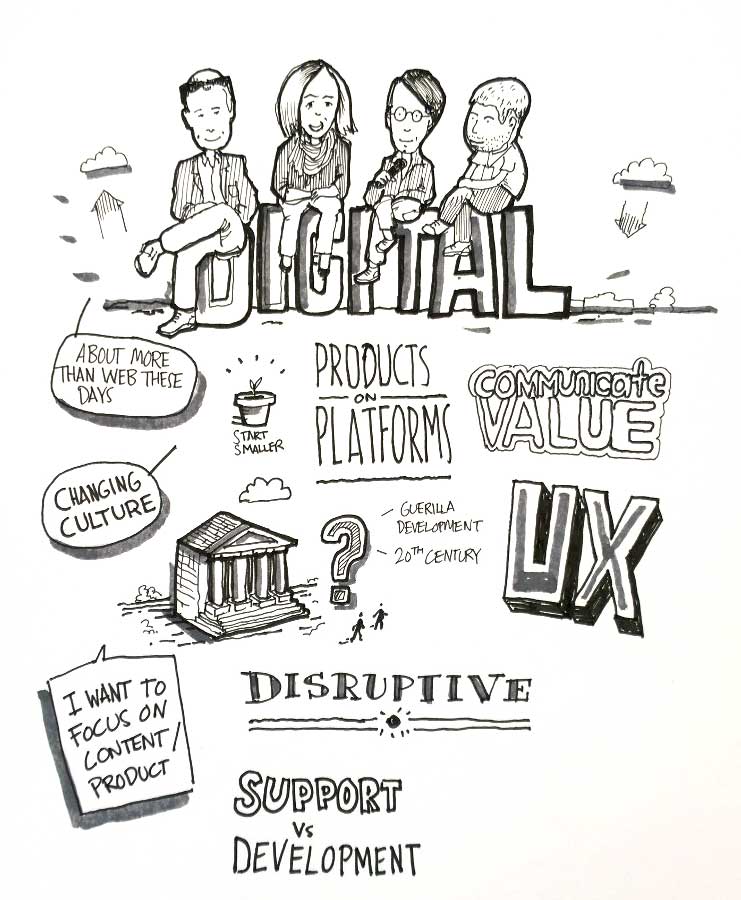
The final session asked: “what is our vision for the institutional web and can we implement that vision?” This was led by a panel of Stephen Emmott (London School of Economics), Mike McConnell (University of Aberdeen), Tracey Milnes (York St John University) and Mike Nolan (Edge Hill University).
The web? There is a problem with it
Stephen Emmott – who recently changed roles from being head of web services to digital communications – noted that the word web now seems old hat. He said that the web is the wallpaper. It’s everywhere. We do ourselves a disservice as a community to think about just the web. We should instead talk about a digital agenda.
We should also avoid naming steering groups ‘web’ something. It’s not about IT; it’s about institutions and organisations.
The panel went on to discuss how our roles have moved away from IT in general as digital media is no longer a technology problem. 10 or 15 years ago we were less sure what technologies we should use for the web. Today that picture is much clearer. It has become clear that the real challenge we face is in managing people and the organisation itself.
Later, Stephen Emmott made the point that IT is a vitally important department. We are desperate for IT help when things go wrong. That is what the IT department is for, and that is how it is seen by others in the institution.
This crystallised my thinking on the issue. IT is an inherently negative environment to be in. The structures surrounding it are all about fixing things. Digital teams working under an IT department get put in that box. Their job is to fix things. They then get caught up in a vicious circle of support, and never get the space to actually improve their products.
One delegate remarked that the web and digital communication is about what the printing press once was. It is a change in the way we communicate, and fundamentally about communication.
Disruptive, social technologies require very little technical management, but require very good content management. The focus should now be on how we use this communication more effectively.
This is a particular challenge since many senior managers are from a certain generation that is still largely paper-based.
The need to change the organisation
This leads us on to the idea that the organisations themselves need changing. It was noted that universities are designed and structured for the 20th century. This is why they find it hard to compete in the digital world.
I was reminded of a slide from Martin Hawksey’s talk. He remarked that universities are decentralised, or centralised in some cases. Meanwhile the rest of the world has moved on to using distributed networks and methods of working.

Mike Nolan said that sometimes you have to do things under the radar to get things done, and I can certainly testify to that. He said that digital teams need to drive developments themselves more to make progress.
A major theme to emerge from this session is that our roles are now about managing the organisation, facilitating relationships between departments, and culture change.
Tying transformation together
That final session reassured me that the approach we are beginning to take at the University of St Andrews is the correct one.
When we first started working on the Study at St Andrews website with the Lean group, one of the phrases we often returned to was culture change. A lot of the work I have done subsequently has been in building relationships with different parts of the University.
Since we are now looking at digital as a whole across the University, I am aiming for us to retain as much of that approach as possible. It is tempting to sit in your own office and wait for problems to come to you, particularly if you are in an IT environment. But over the past year I have learned the great value of getting out and about and speaking to other parts of the University.
Now is a good time to do it. I am excited to see various important digital and organisational projects across the University appearing to make better progress. With a Change unit even being set up here, it seems as though there is a fair wind for change. I am excited to find out what we can achieve in digital – and beyond – in this environment.
Social media and statistics
But away from those big ideas were some other useful insights about our jobs. This post looks at some advice on social media and the use of statistics.
IWMW 2014 kicked off with a fabulous presentation from Tracy Playle of Pickle Jar Communications: Why you don’t need a social media plan and how to create one anyway. I learnt a great deal about social media in a very short space of time.
What you need is a content strategy
The bottom line of Tracy Playle’s presentation was that you do not need a social media strategy. What you need is a content strategy. You need to look at the role social media plays in the wider marketing strategy. As with everything else, you need to look beyond the silos.
Your plan needs to look at the audience engagement journey throughout the year, and use social media in the most appropriate way. The website needs to connect with other channels. She gave the example of a webpage about sleep. This may be of most relevance at 2am the night before an exam. So that is when you should push it on social media.
This again touches on Neil Allison’s talk about user experience. Digital communications need to work seamlessly with real life interactions.
But the strongest point made was that good social media requires balls. The content may have to be controversial, and it has to be something that makes people laugh, because that’s what people like. You won’t have a strong media presence decided by committee. That sometimes scares us in higher education, but it shouldn’t.
Tracy Playle also shared some eyebrow-raising insights about universities. There was one suggestion that students who choose to attend Newcastle University may do so because of Geordie Shore.
Sector statistics
More analysis came later on from Ranjit Sidhu of Statistics into Decisions.
Among his findings are that the most popular hashtag for universities is #yespimpmysummerball (with 188,279 tweets and 17 million impressions). On top of the Geordie Shore revelation, that is another tough lesson to swallow for proud universities.
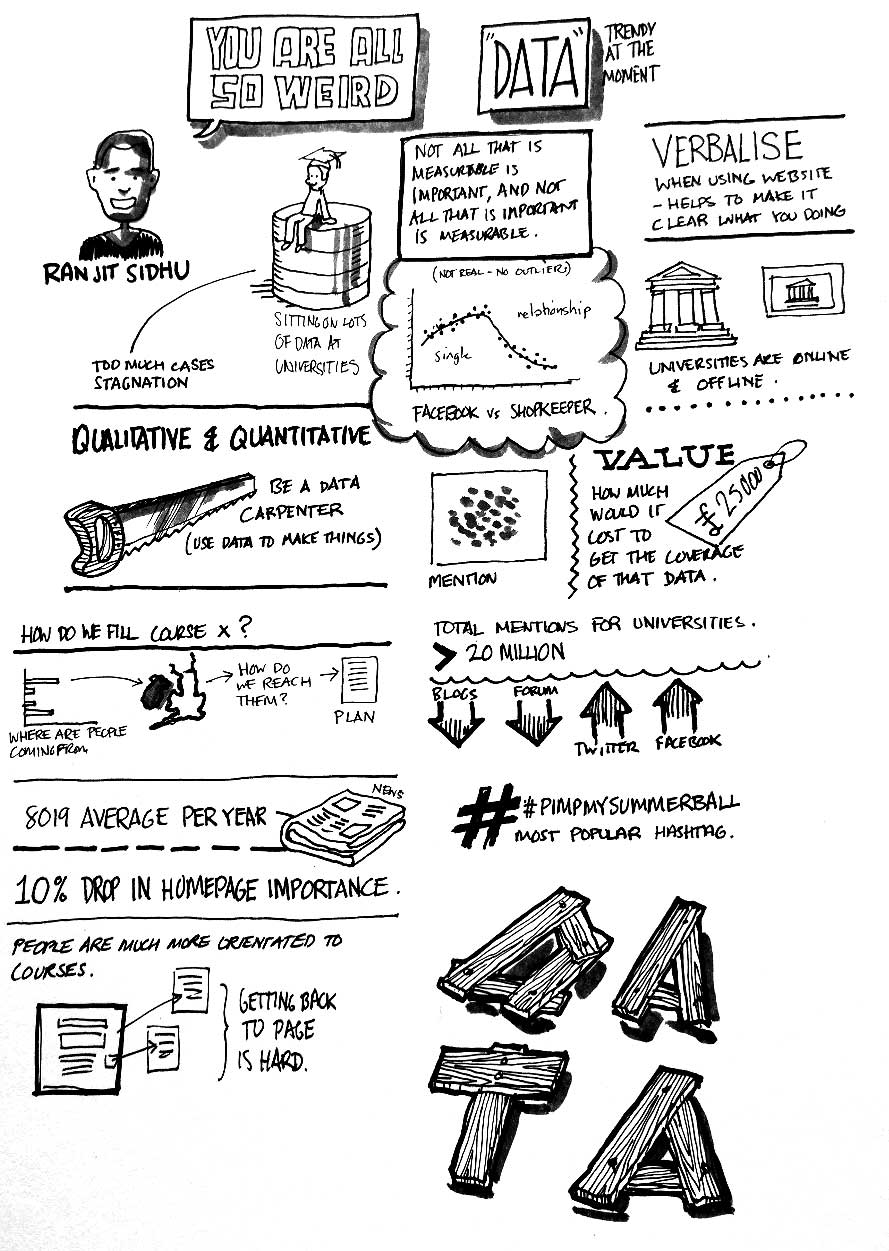
Ranjit noted that mentions of universities on blogs and forums is down. But Twitter, Facebook and Instagram are all platforms we should be looking at.
Facebook has become “the university noticeboard”. Universities generally undervalue Facebook as a marketing tool. But Ranjit noted that in the past year or so it has become a mature market, particularly for international students. If you have a relevant story for a student in an international country, you could potentially hit a large market.
As for the web, Ranjit has found that the homepage is in decline, and is nothing like as important as it used to be. Users are much more course-focussed. This reflects what we see in our analytics at St Andrews.
Course pages are vitally important, particularly as students are expecting higher standards in return for the tuition fees they pay. But according to Ranjit, exit rates on university course pages are high. Students are getting there, but then they go back to the homepage, then they try again, then they exit.
We know from our own experience that it is hard to get course pages right. Hopefully we will be able to improve on them soon.
Portals — Learning lessons from Edinburgh
On the final day of IWMW there was an entertaining and useful talk about portals by Martin Morrey from the University of Edinburgh. Their MyEd portal was a source of inspiration when the University of St Andrews developed iSaint. So it was interesting to learn more about Edinburgh’s experience.
In some circles portal is a dirty word because it is difficult to pin down exactly what is meant by it. We were once told that a portal is “anything with a web interface”, which makes you wonder why they don’t just call it a website.
Martin Morrey shared a Gerry McGovern quote:
A portal is like a website… except it takes five times longer to develop.
It helps to have clarity about what you actually want to achieve, which is why I like to avoid using the word portal.
Martin said that the dream is for the portal to just become part of the website. They should be flipsides of the same thing.
That is certainly what we should be aiming for here as well. There are plans to implement a common look and feel across all digital platforms. There is talk about disguising the branding of our various systems. Users should not have to think: “should I log into iSaint for this, Moodle for that, e-Vision for the other?” There should be a unified user experience.
On mobile
Like St Andrews, Edinburgh have trialled apps as their mobile presence. Edinburgh had a mobile app called U@Ed, which shared a lot of the functionality of MyEd. The University of St Andrews has had two stabs at creating a mobile app. First there was mSaint. Now we have St Andrews Mobile.
Martin shared some interesting statistics on how Edinburgh’s mobile offerings have fared. They found that the U@Ed mobile app gets very little usage. More people were in fact trying to access the web version of MyEd on their mobile device.
MyEd
- 300,000 visits a week.
- 30,000 mobile visit a week.
U@Ed
- 9,000 downloads from app stores.
- Under 1,000 visits a week.
This tallies with our experience at St Andrews. Anecdotal evidence suggests that the mobile app is not heavily used. It is generally recognised that users do not like to go through the hassle of downloading, installing and running a mobile app just to access the information they want.
Edinburgh are now focusing on creating one place that works on all devices, reflecting what users want.
It is an interesting time for us to consider these issues here at St Andrews. We are currently investigating the creation of an intranet. Whether (and how) we should use portal-like concepts, and whether we should continue with iSaint, are bound to be big topics of discussion.